
A scope-assisted lower trapezius transfer is a modern shoulder surgery that helps restore motion and strength when the rotator cuff cannot be repaired.
A lower trapezius transfer is a tendon-transfer procedure used when the rotator cuff - especially the posterior cuff - is torn beyond typical repair. In this surgery, the lower trapezius muscle is redirected to help the shoulder move and stabilize again. With the scope-assisted (arthroscopic-assisted) technique, the procedure is performed through small incisions, reducing tissue damage and improving recovery.
This technique was pioneered and led by Dr. Bassem Elhassan, a respected colleague of Dr. Romeo.
“A lower trapezius transfer can restore control and function in shoulders with irreparable rotator cuff tears.”
Why treatment is required
This surgery is recommended when the rotator cuff - usually the supraspinatus and infraspinatus - is too damaged to repair and the shoulder becomes weak, painful, or unstable. The lower trapezius muscle fibers pull in a similar direction as the posterior rotator cuff, making it an excellent substitute.
Patients with posterior rotator cuff tears often experience:
- Difficulty lifting the arm
- Weakness during overhead activity
- Trouble reaching outward or rotating the arm
- Ongoing shoulder pain or fatigue
Without treatment, shoulder function may continue to decline, limiting daily activities and placing more stress on other structures in the joint.
How treatment is performed
A scope-assisted lower trapezius transfer combines arthroscopy with a small open incision.
First, the surgeon uses a small camera (scope) to assess the shoulder joint and prepare the attachment site on the upper arm bone (humerus). The damaged rotator cuff tissue is evaluated and areas of inflammation or bone spurs may be cleaned.
Next, through a small incision along the upper back, the lower trapezius tendon is released and connected to a tendon graft - usually an Achilles or hamstring allograft. This graft is then brought down to the humerus and secured with strong anchors.
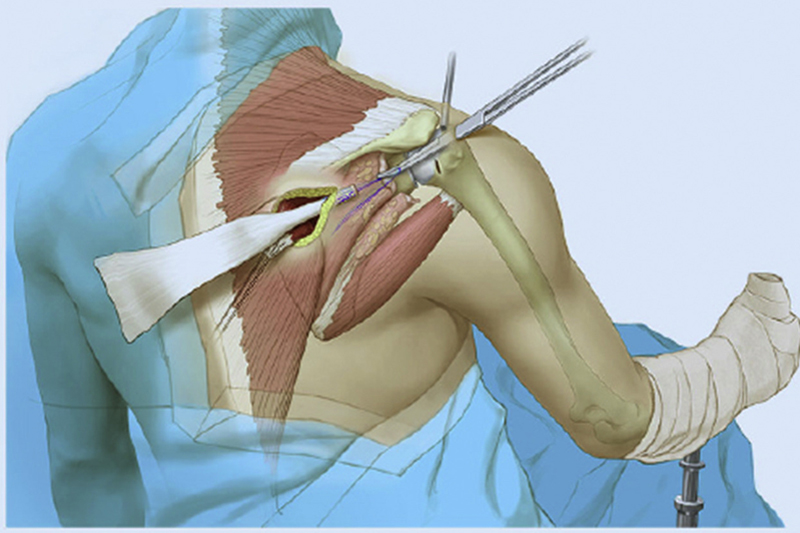
This technique emphasizes precise tendon tension, graft shaping, and secure fixation. Because of careful tendon alignment, the shoulder regains a more natural movement pattern.
Most patients go home the same day.
Risks and benefits
Common risks include:
- Infection
- Stiffness
- Failure of the graft to heal
- Blood loss
Benefits include reduced pain, improved overhead function, better shoulder stability, and the ability to return to activities that were not possible before surgery.
“This procedure recreates the shoulder’s natural mechanics by restoring the direction of pull lost from a torn rotator cuff.”
Physical therapy protocols
Recovery relies heavily on physical therapy. Early therapy focuses on protecting the repair and improving passive motion. Later stages build strength in the lower trapezius and surrounding muscles to retrain proper shoulder mechanics.
Pain control
Pain is managed with a combination of ice, anti-inflammatory medications, and nerve-block techniques. Oral pain medicines may be used as the numbing block wears off. Most patients notice that discomfort improves steadily over the first few weeks.
Recovery time
The arm is supported in a specialized brace for 4 to 6 weeks.
General recovery timeline:
- 0 - 6 weeks: Protection and gentle passive motion
- 6 - 12 weeks: Increasing motion and early strengthening
- 3 - 6 months: Functional strength returns
- 6 - 12 months: Full recovery for most patients
Because this is a tendon-transfer procedure, patience and consistency with therapy are essential.
Results
Most patients experience improved strength, better arm control, and the ability to perform activities that were previously too painful or difficult. While the shoulder may not feel exactly like it did before the injury, the majority of patients achieve meaningful, long-lasting improvements in daily function.
FAQs
Is this surgery for all rotator cuff tears?
No. It is designed for irreparable tears of the posterior cuff. The tear could be irreparable for a number of reasons. Some of these may include: A chronic tear with substantial fatty infiltration into the muscle and a severely retracted tear.
Why the lower trapezius?
Its natural direction of pull closely matches the rotator cuff, leading to better shoulder mechanics. The trapezius is made of three parts: The upper, middle, and lower trapezius muscles. Because the patient will continue to have the upper and middle trapezius in their natural positions, the strength of the trapezius is preserved.
Will I have scars?
Yes, but they are small, particularly with the scope-assisted technique.
Is the graft permanent?
Yes. The tendon graft connects the lower trapezius to the arm and becomes part of your body as it heals.
Schedule a consultation with Dr Romeo in Burr Ridge
If you have been told you have an irreparable rotator cuff tear or continue to struggle with weakness and pain, contact our office. We can evaluate your shoulder, review imaging, and determine whether a scope-assisted lower trapezius transfer is the right solution for you.